The easiest EV charging advice is also the least helpful: “Just get a Level 2 charger.” That works for many drivers. It does not work for every house, every utility plan, or every EV owner who wants solar charging to do more than look good on an app screen.
AC charging sends alternating current to the vehicle, and the EV’s onboard charger converts it to DC for the battery. DC charging handles that conversion in the charger itself. The difference sounds technical, but it shows up in ordinary ways: speed, installation complexity, equipment cost, and how neatly the charger fits into a home’s energy system.
When AC charging is the sensible default
For a driver who leaves the car parked overnight, AC Level 2 charging is often enough. The Department of Energy’s Alternative Fuels Data Center says Level 2 equipment can add about 25 miles of range per hour, with units ranging from 2.9 to 19.2 kW. Most daily driving simply does not demand more.
AC chargers also tend to be easier to explain to electricians and permitting offices. A dedicated circuit, proper load calculation, safe wiring, and a compatible connector usually solve the basic problem.
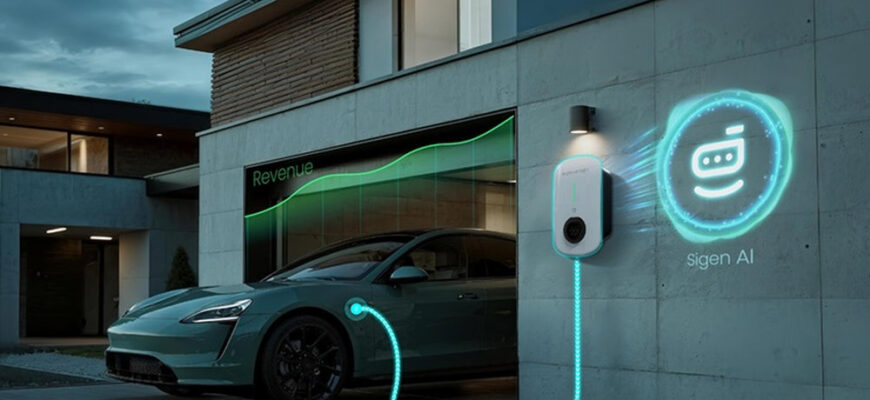
The better AC units now do more than push power into a car. A charger such as the Sigen EV AC Charger can sit inside a broader solar-plus-storage setup, where charging can be scheduled around household energy priorities rather than treated as a dumb load.
When DC starts to make sense
DC charging becomes more interesting when the EV is part of a larger energy plan. A home with rooftop solar may want to charge from PV surplus during the day. A household with a battery may want faster charging without pulling all the power from the grid at once. A driver with irregular trips may value shorter charging windows.
There is also the future-use question. Bi-directional DC charging can support V2H, which lets a compatible EV send energy back to the home during an outage. That is not the same as plugging a refrigerator into a portable inverter. It requires compatible equipment, vehicle support, controls, and local approvals.
A simple way to choose
The decision is rarely AC good, DC bad, or the reverse.
It is closer to this:
| Situation | Usually points toward |
| One EV, regular commute, overnight parking | AC Level 2 |
| Two EVs and limited charging windows | Higher-power AC or DC |
| Solar surplus and home battery already installed | Smart AC or DC-integrated setup |
| Backup power from EV is a goal | Bi-directional DC or V2X-ready equipment |
That table leaves out one thing: the utility bill. Time-of-use rates can make a slower charger cheaper if the car has all night to charge. A faster charger can make sense when charging must fit into a short, low-price window.
Do not buy around a single car
The EV in the garage today may not be the EV there five years from now. Connector standards, charging limits, and V2X support keep moving. The most durable home setup is one that handles current needs without boxing in the next vehicle. That small margin of flexibility can matter when a household later adds a second EV or changes its utility plan.
For households leaning toward everyday home charging with solar-aware control, the bi-directional DC charging option is worth comparing before stepping up from a simpler AC design.